Free tool
Sod Calculator
Measure your lawn once and get an order you can give to the sod farm. Add up to three areas in any mix of rectangles, circles and triangles, choose a waste allowance, and the calculator returns square feet, standard 16 x 24 inch pieces, rolls and pallets.
Sod calculator
Area 1
Area 2 (optional)
Area 3 (optional)
Sod to order
1,320 sq ft
Pallets
3
Slabs, 16 x 24 in
495
Rolls (10 sq ft)
132
Lawn area
1,200 sq ft
Lawn area (m2)
111.5
Pallets, exact
2.93
Material cost
Enter a price
1,200 sq ft x 1.10 = 1,320 sq ft. One 16 x 24 in slab is 2.67 sq ft, so that is 495 slabs. At 450 sq ft per pallet it is 2.93 pallets, rounded up to 3. Farms differ in how they cut and stack sod, so confirm the pallet size and the cut before you order. The cost is only the square feet you need times your price. Delivery and whole pallets can change the final bill.
How to calculate how much sod you need
Worked example: a 40 x 30 ft lawn is 1,200 sq ft. With 10% extra, you need 1,320 sq ft. A 16 x 24 inch slab covers 2.67 sq ft, so that is 495 slabs. At 450 sq ft per pallet it is 2.93, so you order 3 pallets.
- Sketch the lawn and split it into simple shapes: rectangles, circles and triangles. Measure each one in feet.
- Find each area. Rectangle: length times width. Circle: 3.14 times the radius squared. Triangle: half the base times the height.
- Add the areas together. Subtract any beds, patios or paths that sit inside the lawn, or measure the grass around them as separate rectangles.
- Add a waste allowance. Five to ten percent is common for a plain lawn, and more for a lawn with many curves.
- Divide by the size of one piece, or by the coverage of a pallet, and round up. You cannot buy part of a piece.
Sod pieces, rolls and pallets: sizes and coverage
Sod is cut differently from farm to farm. Southern grasses such as Bermuda, zoysia and St. Augustine are usually sold as slabs. In the north you often see rolls. The calculator uses the 16 x 24 inch slab as its standard piece because it is the most quoted size, and lets you pick a roll size and a pallet size too.
| Form | Size | Area each | Pallet coverage |
|---|---|---|---|
| Slab | 16 x 24 in | 2.67 sq ft | 400, 450 or 500 sq ft |
| Mini hand roll | 40 x 18 in | 5 sq ft | 400, 450 or 500 sq ft |
| Large roll | 60 x 24 or 80 x 18 in | 10 sq ft | 500, 600 or 700 sq ft |
Because pallet size varies, the pallet field in the tool is editable. 450 sq ft is a common figure, but type in your farm's number. A 16 x 24 in slab is exactly 384 sq in, or 2.667 sq ft. Some farms list it as 2.66 sq ft, so a few pieces either way will not matter.
How much extra sod to order
Cutting around edges, beds and corners wastes some sod, and a few pieces always break or dry out. Sod Solutions advises ordering 5% to 10% extra. Another calculator suggests going up to 20% if the lawn has many trees, rocks or round edges. The middle row below is our own suggestion, not a quote from a source.
| Lawn shape | Extra to add | Why |
|---|---|---|
| Simple rectangle, few cuts | 5% | Only the end of each row is trimmed. |
| Normal yard with a few curves or beds | 10% | Top of the usual 5 to 10% range. |
| Many curves, trees or tight corners | 15 to 20% | Lots of off-cuts. Up to 20% is cited for busy lawns. |
Sod needed for common lawn sizes
These figures use 10% extra, 16 x 24 in slabs and 450 sq ft pallets. Pallets are rounded up.
| Lawn area | Sod to order | Slabs | Rolls (10 sq ft) | Pallets (450 sq ft) |
|---|---|---|---|---|
| 500 sq ft | 550 sq ft | 207 | 55 | 2 |
| 1,000 sq ft | 1,100 sq ft | 413 | 110 | 3 |
| 1,500 sq ft | 1,650 sq ft | 619 | 165 | 4 |
| 2,000 sq ft | 2,200 sq ft | 825 | 220 | 5 |
| 5,000 sq ft | 5,500 sq ft | 2,063 | 550 | 13 |
How sod pieces are laid, and why it matters for your order
Penn State Extension and University of Maryland Extension both advise laying sod in a staggered pattern, like bricks. Each row starts half a piece over from the row before, so the seams do not line up. Pieces are pressed edge to edge without overlap. Every row that starts with a half piece makes a cut piece at each end, which is where most of the waste comes from.
- Lay the first row along a straight edge, such as a driveway or path, then work out from it.
- Press edges together without overlap, and avoid stretching a piece to close a gap.
- Walk on a plank, not on the new sod, so you do not dent the soil under it.
- Order close to the install day. University of Maryland Extension notes that sod is perishable and should go down quickly after delivery.
- Water right after laying. The same source says roots take about 2 to 3 weeks to establish, and that sod can be laid any time the ground is not frozen and daytime temperatures stay below 90 F.
Estimating the cost of sod
Sod prices change with the grass type, the region, the season and whether delivery is included, so this tool does not guess a price. Ask your local sod farm for a price per square foot or per pallet, and type it into the price box to see the material cost.
The estimate is the square feet you need times your price. Farms usually sell whole pallets, so the final invoice for a part pallet may be higher. Add delivery and any soil preparation on top.
If the soil under your new lawn is poor, check how much topsoil it needs before the sod arrives. The topsoil calculator on this site gives cubic yards for the depth you pick.
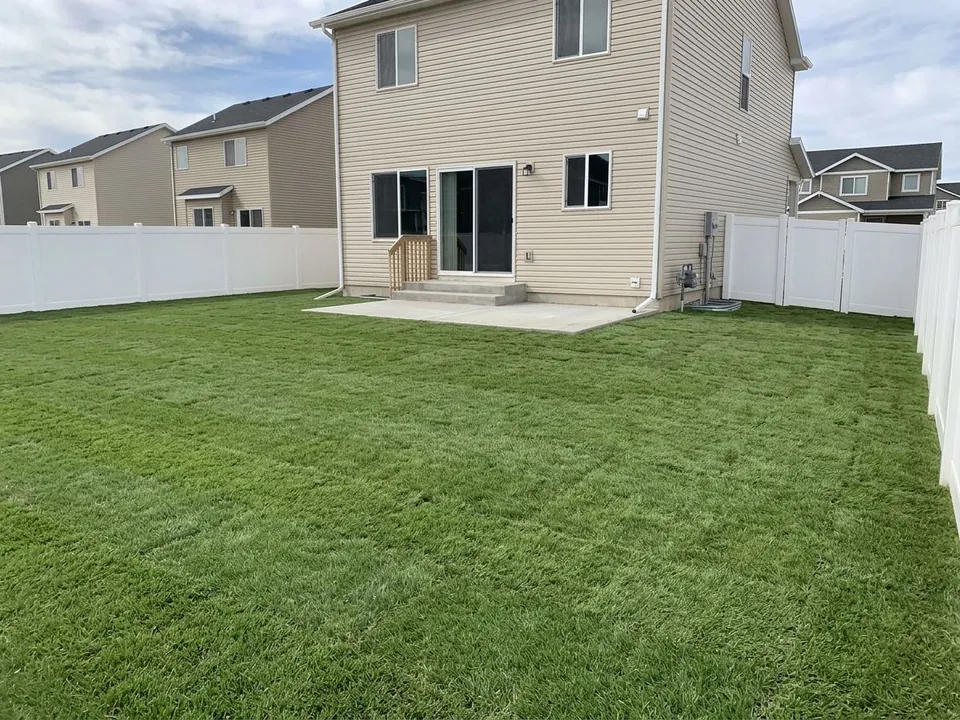
See a fresh lawn on your own yard
Upload a photo of your yard and our AI landscape tool renders a new lawn, paths and planting beds in it, so you can see the finished look before you order sod.
Try the AI landscape designSign in with Google or email to render. New accounts get 1 free render (watermarked).
Frequently asked questions
How do I calculate how much sod I need?
Measure the lawn in feet, work out its area, and add 5% to 10% for cuts. Divide by the area of one piece or pallet and round up. A 1,000 sq ft lawn with 10% extra needs 1,100 sq ft, which is 413 slabs of 16 x 24 inches or 3 pallets of 450 sq ft.
How many square feet are on a pallet of sod?
Most pallets cover 400 to 500 sq ft, and 450 sq ft is the figure quoted most often. Pallets of large rolls can hold 500 to 700 sq ft. It depends on the farm and the grass, so ask your supplier and enter their number in the pallet field.
How big is a standard piece of sod?
The most quoted slab is 16 x 24 inches, which is 2.67 sq ft. Rolls are common too: about 5 sq ft for mini hand rolls and 10 sq ft for large rolls. There is no single standard, because each farm cuts its sod its own way.
How much extra sod should I order?
Order 5% to 10% more than your measured area. Go higher, up to about 20%, if the lawn has many curves, trees or tight corners, because each cut leaves off-cuts you cannot reuse.
How do I measure an irregular lawn for sod?
Break it into rectangles, circles and triangles, measure each, and add the areas. This calculator takes up to three shapes. For more, add some of them together by hand and enter the total as one rectangle, such as 1 ft by the total number of square feet.
How many rolls of sod do I need per 1,000 sq ft?
With 10% extra you need 1,100 sq ft. That is 110 rolls of 10 sq ft, 123 rolls of 9 sq ft or 220 mini rolls of 5 sq ft.
More free tools for architects and designers
- AI landscape design
- Backyard landscaping ideas
- Raised garden bed ideas
- Topsoil calculator
- Gravel calculator
- Small backyard ideas
- Pool landscaping ideas
- How to design a backyard with AI
- Room size calculator
- Deck calculator
- Tile calculator
- Roof pitch calculator
- Architectural scale converter
- Cost to build a house calculator
- King size bed dimensions
- Standard door sizes
- Standard window sizes
- Bathroom vanity height
- Two car garage dimensions
- 1200 sq ft house plans
- Free house plans
Sources: Slab, roll and pallet sizes, and the 5 to 10% extra, from the Sod Solutions guide to square feet per pallet; slab and roll sizes also cross-checked with Hunker and The Grass Outlet. Pallet coverage of 450 to 500 sq ft and slabs of 2.67 sq ft from the Inch Calculator sod page. Waste of up to 20% for busy lawns from the Omni Calculator sod page. Staggered laying from Penn State Extension and University of Maryland Extension (roots in 2 to 3 weeks, install soon after delivery). Pallet size and cut differ by farm, so confirm with your supplier.