Free tool · no sign-up
Roof Pitch Calculator
Enter the rise and run (or the angle) to get the roof pitch in x/12, degrees and percent. Add the building size to get the rafter length, ridge height, roof area and how many squares of roofing to order.
Roof pitch calculator
Pitch
6/12
Angle
26.6°
Grade
50.0%
Pitch multiplier
1.118
Common rafter (to ridge center)
17.89 ft
Ridge height above wall
7.50 ft
Roof area
1,503 sq ft
Roofing squares
15.0
Hip rafter (no overhang): 22.50 ft. A valley rafter is the same only when both roofs have the same span. Rafter length is to the ridge center: deduct half the ridge board. Roof area counts the footprint plus overhangs times the pitch multiplier, and works for gable and hip roofs with one pitch on every side.
How to measure roof pitch
From plans, use the drawn rise and half the building span. A house 30 ft wide with the ridge 7.5 ft above the wall plate has a rise of 7.5 over a run of 15, which is 6/12.
- Hold a level against the underside of a rafter or on the roof surface.
- Mark 12 inches along the level from where it touches the roof. That is the run.
- Measure straight down (or up) from the 12 inch mark to the roof. That number of inches is the rise.
- A rise of 6 inches over a 12 inch run is a 6/12 pitch, also written 6:12 or 6 in 12.
Roof pitch chart: angle, grade and multipliers
The pitch multiplier (slope factor) turns a flat measurement into the true length along the roof. Multiply the plan area by it to get the roof surface area. The hip/valley factor gives the hip rafter length per foot of common run.
| Pitch | Angle | Grade | Pitch multiplier | Hip/valley factor |
|---|---|---|---|---|
| 1/12 | 4.8° | 8.3% | 1.003 | 1.417 |
| 2/12 | 9.5° | 16.7% | 1.014 | 1.424 |
| 3/12 | 14.0° | 25.0% | 1.031 | 1.436 |
| 4/12 | 18.4° | 33.3% | 1.054 | 1.453 |
| 5/12 | 22.6° | 41.7% | 1.083 | 1.474 |
| 6/12 | 26.6° | 50.0% | 1.118 | 1.500 |
| 7/12 | 30.3° | 58.3% | 1.158 | 1.530 |
| 8/12 | 33.7° | 66.7% | 1.202 | 1.563 |
| 9/12 | 36.9° | 75.0% | 1.250 | 1.601 |
| 10/12 | 39.8° | 83.3% | 1.302 | 1.641 |
| 11/12 | 42.5° | 91.7% | 1.357 | 1.685 |
| 12/12 | 45.0° | 100% | 1.414 | 1.732 |
| 14/12 | 49.4° | 116.7% | 1.537 | 1.833 |
| 16/12 | 53.1° | 133.3% | 1.667 | 1.944 |
| 18/12 | 56.3° | 150% | 1.803 | 2.062 |
Common roof pitches and what they are used for
- Flat to 2/12 (low slope): needs a membrane roof (TPO, EPDM, modified bitumen) or standing-seam metal rated for low slope. Common on modern houses, porches and commercial buildings.
- 2/12 to 4/12: the minimum range for asphalt shingles. Below 4/12, shingles need a double layer of underlayment.
- 4/12 to 9/12 (conventional): the most common range for US houses, and suits shingles, metal, tile and slate. Up to about 6/12 a roofer can walk it; from about 8/12 roofers use roof jacks and a harness.
- 9/12 and steeper: Tudor, Victorian, A-frame and Gothic styles. Sheds snow fast and gives usable attic space, and roofers always work from roof jacks with a harness.
Hip roof calculator
A hip roof slopes down on all four sides. When every side has the same pitch, the roof area is the same as a gable roof over the same footprint: plan area (with overhangs) x pitch multiplier. The calculator above uses this.
The hip rafter runs at 45° in plan, so its run is 16.97 inches for every 12 inches of common run. Its length is the half span x the hip/valley factor from the chart. On a 30 ft wide house with a 6/12 pitch: 15 x 1.500 = 22.5 ft before the overhang.
Pitch, slope and angle: the difference
In US building practice, pitch and slope are both written as rise over 12 inches of run (6/12). Strictly, pitch is rise over the full span, so a 6/12 slope is a 1/4 pitch, but almost no one uses that today. Angle is the same slope in degrees: angle = arctan(rise ÷ run). Grade or percent slope is rise ÷ run x 100.
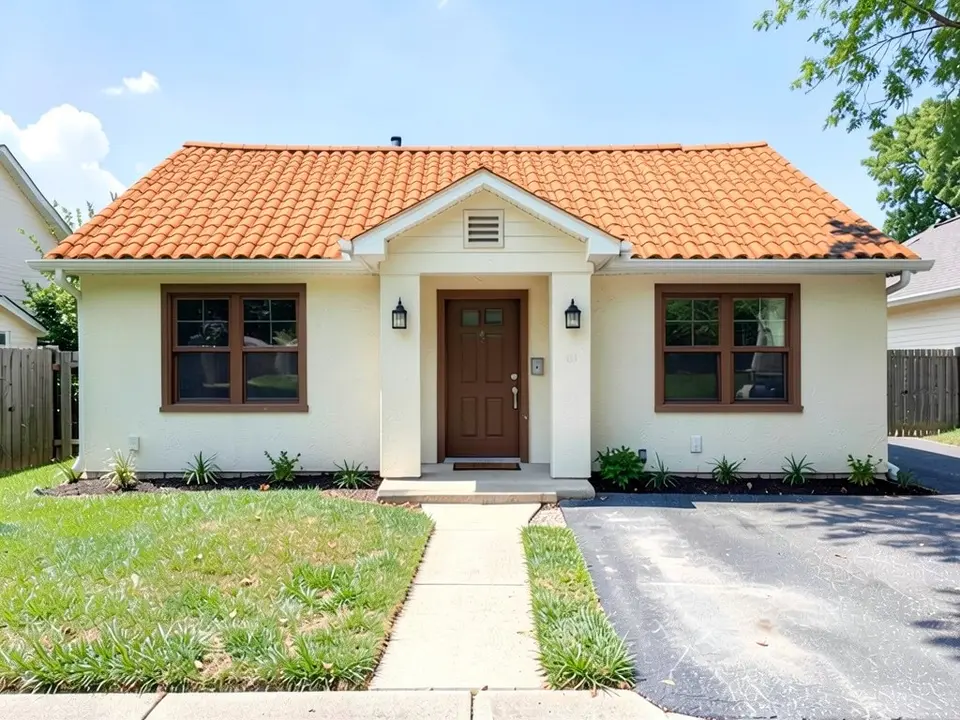
See a new roof on your house
Upload a photo of your house and our AI shows it with a new roof shape, material and color: metal, slate, tile or shingles. Compare options before you call a roofer.
Try the AI roof design toolSign in with Google or email to render. New accounts get 1 free render (watermarked).
Frequently asked questions
How do I calculate roof pitch?
Divide the rise by the run and multiply by 12. A roof that rises 4 ft over an 8 ft run is (4 ÷ 8) x 12 = 6, so it is a 6/12 pitch.
What is a 6/12 roof pitch in degrees?
A 6/12 pitch is 26.6 degrees, or a 50% grade. Its pitch multiplier is 1.118, so the roof surface is about 12% larger than the floor plan below it.
What is the most common roof pitch?
Most US houses have a pitch between 4/12 and 9/12, with 6/12 the most common. It sheds rain and snow well, works with shingles, and a roofer can still walk on it.
What is the minimum pitch for shingles?
Asphalt shingle makers allow 2/12 as the minimum, but slopes from 2/12 up to 4/12 need extra underlayment. Below 2/12, use a low-slope membrane or a metal roof rated for it.
How many squares is my roof?
One roofing square is 100 sq ft. Multiply the house footprint (with overhangs) by the pitch multiplier, then divide by 100. Add 10 to 15% for waste, starter rows and ridge caps.
How do I convert roof pitch to degrees?
Use angle = arctan(rise ÷ 12). For 8/12 that is arctan(0.667) = 33.7 degrees. The chart on this page lists the angle for every common pitch.
More free tools for architects and designers
- AI roof design
- AI hip roof design
- Tile calculator
- Architectural scale converter
- Cost to build a house calculator
- King size bed dimensions
- Standard door sizes
- Standard window sizes
- Bathroom vanity height
- Two car garage dimensions
- 1200 sq ft house plans
- Free house plans
Sources: Minimum slopes follow the International Residential Code (IRC R905). Angles and multipliers are computed with the formulas shown.