Free tool
Gravel Calculator
Work out how much gravel to order before the truck arrives. Pick a shape, enter the size and the depth, choose the type of stone, and the calculator returns cubic yards, cubic feet, cubic meters, tons and the number of bags.
Gravel calculator
Cubic yards
1.02
Tons (US)
1.43
Cubic feet
27.5
Cubic meters
0.78
Bags (0.5 cu ft)
55
Area
100 sq ft
Metric tonnes
1.29
Weight used
1.4 t/yd3
100 sq ft x 0.250 ft deep = 25.0 cu ft. With 10% extra that is 27.5 cu ft, or 1.02 cubic yards. At 1.4 tons per cubic yard that weighs about 1.43 US tons. Tons are US short tons (2,000 lb). Real gravel varies by quarry and moisture, so check the weight your supplier quotes.
How to calculate how much gravel you need
Worked example: a 10 x 10 ft square at 3 inches deep is 100 sq ft x 0.25 ft = 25 cu ft. That is 0.93 cubic yards. With all-purpose gravel at 1.4 tons per cubic yard it weighs about 1.3 tons. Add 10% and the order becomes about 1.02 cubic yards, or 1.43 tons.
- Measure the area in feet. For a rectangle, take the length and the width. For a circle, measure across the widest point. For a triangle, take the base and the height.
- Find the area. A rectangle is length times width. A circle is 3.14 times the radius squared. A triangle is half the base times the height. Split odd shapes into these pieces and add them up.
- Turn the depth into feet by dividing the inches by 12. A 3 inch layer is 0.25 ft.
- Multiply area by depth to get cubic feet, then divide by 27 to get cubic yards. One cubic yard holds 27 cubic feet.
- Multiply cubic yards by the weight of your stone (tons per cubic yard) to get tons. The table further down lists typical values.
- Add about 10% for settling and spills. If the base will be compacted with a plate compactor, plan for more.
Gravel needed for common project sizes
These figures are for a 3 inch layer of all-purpose gravel at 1.4 tons per cubic yard, before any extra for settling. Bags are 0.5 cu ft.
| Area | Sq ft | Cubic feet | Cubic yards | Tons | 0.5 cu ft bags |
|---|---|---|---|---|---|
| 3 x 20 ft path | 60 | 15 | 0.56 | 0.78 | 30 |
| 10 x 10 ft | 100 | 25 | 0.93 | 1.30 | 50 |
| 10 x 20 ft | 200 | 50 | 1.85 | 2.59 | 100 |
| 12 x 20 ft | 240 | 60 | 2.22 | 3.11 | 120 |
| 20 x 20 ft | 400 | 100 | 3.70 | 5.19 | 200 |
Gravel weight: tons per cubic yard by type
Suppliers sell gravel by the cubic yard or by the ton, and some quote both. The conversion between them depends on the stone. These are rounded figures from a public supplier chart. Another calculator lists wider ranges, for example 1.4 to 1.7 tons per cubic yard for gravel and 1.25 to 1.5 for pea gravel, so treat any single number as an estimate.
| Material | Typical weight | Tons per cubic yard |
|---|---|---|
| Pea gravel, 1/4 to 3/8 in | about 96 lb per cu ft | 1.3 |
| All-purpose gravel, 1/4 to 2 in | about 105 lb per cu ft | 1.4 |
| Crushed stone #57 | about 100 lb per cu ft | 1.35 |
| River rock, 2 to 6 in | about 98 lb per cu ft | 1.3 |
| Decomposed granite | about 110 lb per cu ft | 1.5 |
| Lava rock | about 45 lb per cu ft | 0.6 |
How deep should gravel be?
The right depth depends on what the gravel carries. A path needs only a thin top layer. A shed pad or driveway needs thicker, compacted layers. The depths below come from the guides listed under sources, and they are starting points, not code requirements.
| Use | Typical depth | Notes |
|---|---|---|
| Garden path or walkway | 2 to 3 in of gravel | Lay landscape fabric first. A 4 in build is also common: 2 in compacted base plus 2 in gravel on top. |
| Pea gravel patio | 2 to 3 in of pea gravel | Over a 2 in compacted crushed-stone base. |
| Shed or greenhouse pad | 4 to 6 in | Compact it in layers. |
| Drainage under a raised bed | 2 to 3 in | Angular crushed stone such as #57. |
| French drain | Fill the trench | Use angular stone so water can move between the pieces. |
| Driveway | Built in layers of 4 to 6 in each | One guide builds three layers, with larger stone at the bottom. Soil and traffic change this, so ask your supplier or local authority. |
How much area does one ton of gravel cover?
Divide 27 cubic feet by the tons per cubic yard to find the volume in one ton, then divide by the depth. For all-purpose gravel at 1.4 tons per cubic yard, one ton is about 19.3 cubic feet.
| Depth | Coverage of 1 ton | Gravel per 100 sq ft |
|---|---|---|
| 2 in | about 116 sq ft | 0.62 cu yd, 0.86 tons |
| 3 in | about 77 sq ft | 0.93 cu yd, 1.30 tons |
| 4 in | about 58 sq ft | 1.23 cu yd, 1.73 tons |
| 6 in | about 39 sq ft | 1.85 cu yd, 2.59 tons |
Ordering tips: extra material, compaction and bags
- Order about 10% extra to cover uneven ground and spills. Stone that will be compacted settles further, and one calculator suggests up to 30% extra in that case. Not every gravel needs compacting, so match the extra to the job.
- Bags work well under about half a cubic yard. A 0.5 cu ft bag holds 1/54 of a cubic yard, so one cubic yard is 54 of them. Above that, bulk delivery is usually simpler.
- Check whether your supplier prices by the yard or by the ton, and whether delivery is a flat fee. Enter a custom weight above if their number differs from the table.
- Keep the pile off the lawn. Park the delivery on a tarp or on the driveway, then move it by wheelbarrow.
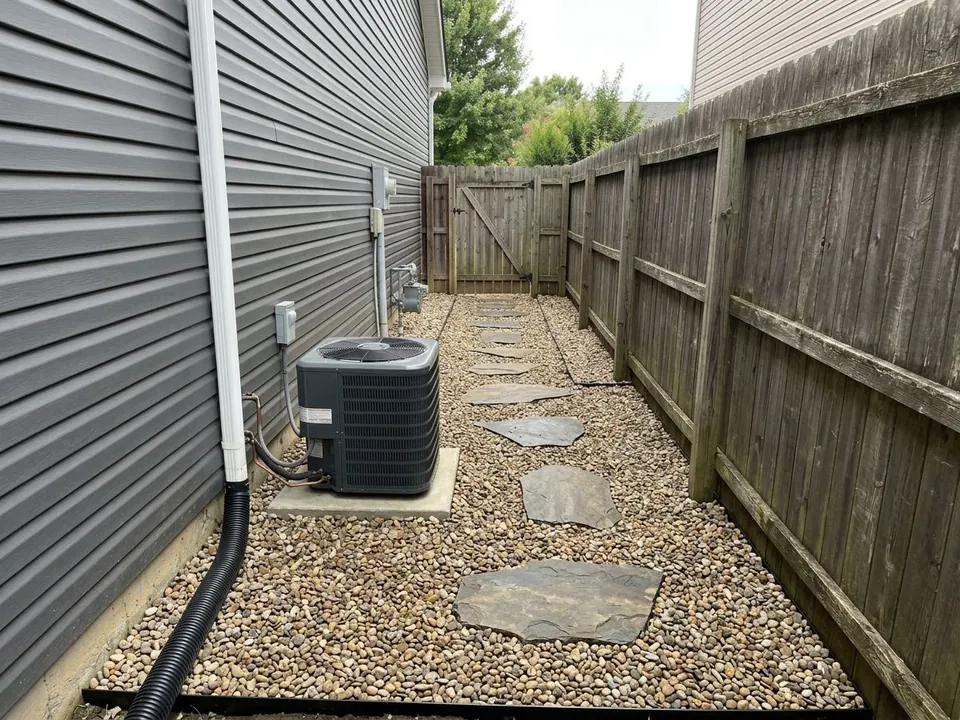
See a gravel garden or path on your own yard
Upload a photo of your yard and our AI landscape tool renders a gravel path, a pea gravel patio or a dry garden in it, so you can pick the layout before you order stone.
Try the AI landscape designSign in with Google or email to render. New accounts get 1 free render (watermarked).
Frequently asked questions
How many cubic yards of gravel do I need?
Multiply length by width by depth, all in feet, then divide by 27. A 10 x 10 ft area at 3 inches deep is 100 x 0.25 = 25 cubic feet, which is 0.93 cubic yards. Add about 10% for settling and spills.
How many tons is a cubic yard of gravel?
About 1.3 to 1.5 tons for most gravel. All-purpose gravel is commonly given as 1.4 tons per cubic yard, and pea gravel as about 1.3. Some calculators list wider ranges, and wet stone weighs more, so use your supplier's number if they give one.
How much does 1 ton of gravel cover?
At 1.4 tons per cubic yard, one ton covers about 116 sq ft at 2 inches deep, 77 sq ft at 3 inches and 58 sq ft at 4 inches.
How deep should gravel be for a path or driveway?
A garden path usually needs 2 to 3 inches of gravel over fabric, or about 4 inches in total with a compacted base. Driveways and shed pads need more, from 4 to 6 inches in compacted layers. Check with your supplier for your soil and traffic.
How many bags of gravel are in a cubic yard?
A cubic yard is 27 cubic feet, so it takes 54 bags of 0.5 cu ft, 36 bags of 0.75 cu ft or 27 bags of 1 cu ft. Bags cost more per yard than bulk, so they suit small jobs.
Should I order gravel by the ton or by the yard?
Either works if you convert correctly. Yards describe the space the stone fills, and tons describe its weight. Ask your supplier which they sell by, and give them the cubic yards from this calculator plus the stone type.
More free tools for architects and designers
- AI landscape design
- Backyard landscaping ideas
- Raised garden bed ideas
- Topsoil calculator
- Sod calculator
- Deck calculator
- Small backyard ideas
- Pool landscaping ideas
- How to design a backyard with AI
- Flooring calculator
- Tile calculator
- Roof pitch calculator
- Architectural scale converter
- Cost to build a house calculator
- King size bed dimensions
- Standard door sizes
- Standard window sizes
- Bathroom vanity height
- Two car garage dimensions
- 1200 sq ft house plans
- Free house plans
Sources: Gravel weights from the Eartheasy gravel calculator material chart (about 96 to 110 lb per cu ft, 2,400 to 2,900 lb per cubic yard) and the Inch Calculator gravel page (1.4 to 1.7 tons per cubic yard for gravel, 1.25 to 1.5 for pea gravel; about 10% extra, up to 30% more for compaction). Path, patio, drainage and shed depths from Eartheasy and the Lawn Love gravel path guide (4 in total: 2 in base and 2 in gravel). Driveway layers from the Bob Vila gravel driveway guide. Conversions: 27 cu ft per cubic yard, 0.0283168 cubic meters per cubic foot. Supplier figures vary by quarry and moisture.