Free tool · no sign-up
Tile Calculator
Work out how many tiles and boxes you need for a floor, wall or shower. Enter the room and tile size, pick a layout pattern, and the calculator adds the right waste allowance for cuts.
Tile calculator
Tiles needed
68
Boxes
9
Floor area
120.0 sq ft
Floor area
11.15 m²
60 tiles cover the floor exactly, plus 15% for cuts and breakage (includes 5% extra for large format tile).
How the tile calculator works
The formula is: tiles = area ÷ ((tile length + grout) x (tile width + grout)), then multiplied by 1 + waste %. The result is always rounded up, because you cannot buy part of a tile.
- Measure the length and width of the area in feet (or meters). For an L-shaped room, split it into two rectangles and add the results.
- Enter the tile size printed on the box. A 12 x 24 tile is 12 inches by 24 inches.
- Enter the grout joint. Each tile covers its own size plus one grout line, so a wider joint means slightly fewer tiles.
- Pick the layout. Diagonal and herringbone patterns need more cuts, so they need more spare tiles.
- Enter how many tiles come in a box (it is on the label) to get the number of boxes to buy.
Tiles per square foot for common sizes
These figures ignore the grout joint, which is how most stores quote them. Use them for a quick check of the calculator above.
| Tile size (inches) | Tiles per sq ft | Tiles per 100 sq ft |
|---|---|---|
| 2 x 2 (mosaic) | 36 | 3,600 |
| 3 x 6 (subway) | 8 | 800 |
| 4 x 24 (plank) | 1.5 | 150 |
| 4 x 4 | 9 | 900 |
| 6 x 6 | 4 | 400 |
| 6 x 24 (plank) | 1 | 100 |
| 8 x 48 (plank) | 0.375 | 38 |
| 12 x 12 | 1 | 100 |
| 12 x 24 | 0.5 | 50 |
| 18 x 18 | 0.44 | 45 |
| 24 x 24 | 0.25 | 25 |
| 24 x 48 | 0.125 | 13 |
How much extra tile to buy (waste factor)
Keep at least one unopened box after the job. Tile batches (dye lots) vary in color, so a matching replacement can be impossible to find a few years later.
| Layout | Add | Why |
|---|---|---|
| Straight grid | 10% | Cuts at the walls and a few breakages |
| Brick or 1/3 offset | 10-12% | More cuts at the ends of every row |
| Diagonal (45°) | 15% | Every edge tile is cut on an angle |
| Herringbone or chevron | 15-20% | Many small cuts along every wall |
| Large format (24 in and up) | +5% more | One broken tile is a big share of the area |
Choosing a grout joint size
- Rectified tiles (machine-cut, square edges): 1/16 to 1/8 inch. Use at least 1/8 inch for offset layouts with tiles longer than 15 inches.
- Standard floor tile: 1/8 to 1/4 inch.
- Large format tile (15 inches and longer): 1/8 to 3/16 inch, and check the tile maker’s minimum.
- Handmade or rustic tile with uneven edges: 1/4 inch or more.
A wider joint uses more grout but hides small size differences between tiles.
Wall and shower tile
For a wall, use the wall height instead of the room width. Measure each wall separately and subtract doors and windows larger than about 10 sq ft. For a shower, add the three walls and the floor as separate areas, and add trim pieces (bullnose or edge profile) by the linear foot.
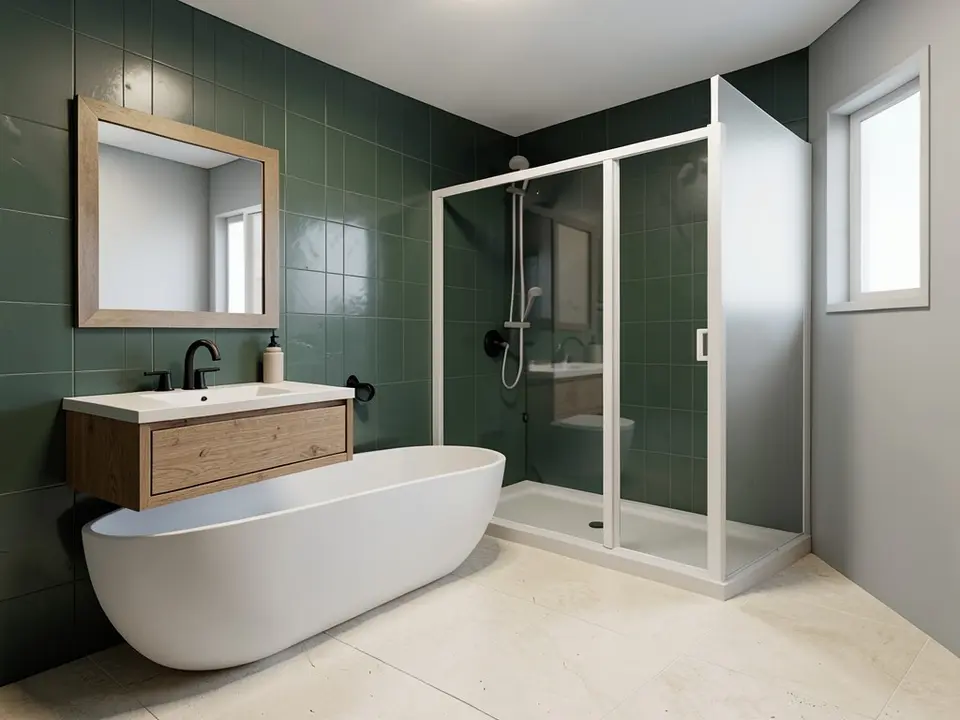
See the tile in your room before you buy it
Upload a photo or a plain 3D view of your bathroom or kitchen and our AI renders it with the tile, color and finish you describe, so you can compare options before ordering boxes.
Try the AI interior renderSign in with Google or email to render. New accounts get 1 free render (watermarked).
Frequently asked questions
How many tiles do I need for a 10 x 10 room?
A 10 x 10 room is 100 sq ft. With 12 x 12 tiles that is 100 tiles before waste, or 110 tiles with 10% extra. With 12 x 24 tiles it is 50 tiles, or 55 with 10% extra. These figures ignore the grout joint. With a 1/8 inch joint the calculator gives 108 tiles for 12 x 12 tile, and it adds 5% more for tiles 24 inches and longer.
How much extra tile should I buy?
Buy 10% extra for a straight layout, 15% for diagonal and 15 to 20% for herringbone. Large tiles and rooms with many corners need the higher end.
How do I calculate tiles per box?
The box label lists the tile count and the square feet it covers. Divide the tiles you need by the tiles per box and round up. For example, 110 tiles at 8 per box is 13.75, so buy 14 boxes.
Does grout width change how many tiles I need?
Slightly. Each tile covers its own size plus one grout line. With small tiles the difference is noticeable: 4 x 4 tiles with a 1/4 inch joint cover about 13% more area each, so you need fewer tiles.
Can I use this for wall tile and backsplash?
Yes. Enter the wall length and height instead of the room length and width. Subtract large openings like windows and doors, and add trim pieces separately.
More free tools for architects and designers
- AI interior visualization
- Roof pitch calculator
- Architectural scale converter
- Cost to build a house calculator
- King size bed dimensions
- Standard door sizes
- Standard window sizes
- Bathroom vanity height
- Two car garage dimensions
- 1200 sq ft house plans
- Free house plans
Sources: Tile sizes and joint widths follow common US manufacturer guidance and ANSI A108 practice. Always check your tile maker’s instructions.