Free tool
Lumens Calculator
Lumens measure how much light a bulb gives. To find how many you need, multiply the room area in square feet by the lumens per square foot for that room. This calculator does it for you, then shows how many bulbs of your chosen brightness to buy.
Room lumens calculator
Lumens needed
2,700
Bulbs needed
4
Target light
15 fc (161 lux)
Light spacing
about 4.0 ft
180 sq ft x 15 lumens per sq ft = 2,700 lumens, divided by 800 lumens per bulb = 3.4, rounded up to 4. Ranges are typical guidance and vary by source. Ceilings above 8 ft get 10% more light per extra foot, a rule of thumb. Spacing for recessed lights is about half the ceiling height.
How many lumens do I need for a room?
Lighting guides give a target in foot-candles, which equals lumens per square foot. A living room is comfortable at about 10 to 20, a kitchen at 30 to 40, and a bathroom vanity at 70 to 80. Multiply by the floor area to get the total lumens for the room.
The ranges below are typical general-lighting targets. They vary between sources, and they are a starting point: lighting you can dim lets you adjust to the task and the time of day.
| Room | Lumens per sq ft | Example room | Lumens needed |
|---|---|---|---|
| Living room | 10-20 | 15 x 12 ft (180 sq ft) | 1,800-3,600 |
| Dining room | 30-40 | 12 x 10 ft (120 sq ft) | 3,600-4,800 |
| Kitchen, general | 30-40 | 12 x 10 ft (120 sq ft) | 3,600-4,800 |
| Bedroom | 10-20 | 12 x 12 ft (144 sq ft) | 1,440-2,880 |
| Bathroom, vanity area | 70-80 | 8 x 5 ft (40 sq ft) | 2,800-3,200 |
| Home office | 30-50 | 10 x 10 ft (100 sq ft) | 3,000-5,000 |
| Laundry room | 30-50 | 8 x 6 ft (48 sq ft) | 1,440-2,400 |
| Hallway | 5-10 | 3 x 12 ft (36 sq ft) | 180-360 |
| Task or reading light | 70-80 | Per lit area | Area x 70-80 |
Lumens calculator formula, step by step
Here is the 15 x 12 ft living room from the calculator above, worked by hand.
- Area: 15 ft x 12 ft = 180 sq ft.
- Target: a living room at the middle of its range is 15 lumens per sq ft.
- Total lumens: 180 sq ft x 15 = 2,700 lumens.
- Bulbs: 2,700 lumens / 800 lumens per bulb = 3.4, so buy 4 bulbs (about 3,200 lumens).
- Tall ceiling: if the ceiling is 10 ft, add about 10% per extra foot, so 2,700 x 1.2 = 3,240 lumens, or 5 bulbs of 800 lumens.
Add all the lights in the room, not only the ceiling ones. Lamps count too, so 1,600 lumens from table lamps leaves 1,100 for the ceiling fixture in the example above.
Lumens to watts: bulb brightness chart
Shop by lumens, not watts. Watts tell you how much power a bulb uses, and an LED gives the same light with far fewer watts than an old incandescent bulb. These are the usual brightness points.
| Lumens | Old incandescent | Typical LED |
|---|---|---|
| 450 | 40 W | 6-9 W |
| 800 | 60 W | 8-12 W |
| 1,100 | 75 W | 11-15 W |
| 1,600 | 100 W | 16-20 W |
How far apart should recessed lights be?
A common rule is to space recessed lights about half the ceiling height apart, and to keep the first row about half of that spacing from each wall. With an 8 ft ceiling, that is 4 ft apart and 2 ft from the wall. The 12 x 8 ft room below fits six lights, in a grid of 3 by 2.
- Six lights at 500 lumens each give 3,000 lumens over 96 sq ft, or about 31 lumens per sq ft, the range for kitchen general light.
- For a 10 ft ceiling, spacing grows to about 5 ft, so you need fewer but brighter lights.
- Lights closer than about 2 ft to a wall throw scallops of light up it. Move them in, or use that on purpose to wash a textured wall.
- Add a dimmer. Then the same lights serve for cooking and for relaxing.
Lumens, lux and foot-candles
Lumens measure the light a bulb gives out. Lux and foot-candles measure the light that lands on a surface. One foot-candle is one lumen per square foot, and one foot-candle is about 10.76 lux. US guides use foot-candles, and most of the rest of the world uses lux.
| Foot-candles | Lux | Where |
|---|---|---|
| 10 | 108 | Living room, bedroom, low end |
| 20 | 215 | Living room, bedroom, high end |
| 30 | 323 | Kitchen, laundry, office, low end |
| 50 | 538 | Home office, high end |
| 80 | 861 | Bathroom vanity, task lighting |
Choose bulb color as well as brightness
Lumens set how bright a bulb is. Color temperature, in kelvins, sets how warm it looks. Around 2700 to 3000 K is a warm white that suits living rooms and bedrooms. Around 3500 to 4000 K is a cooler white that many people prefer in kitchens, bathrooms and offices.
Keep one color temperature in each room, so the bulbs match. Bulbs with a high color rendering index (CRI 90 or more) show food, skin and fabrics more truly.
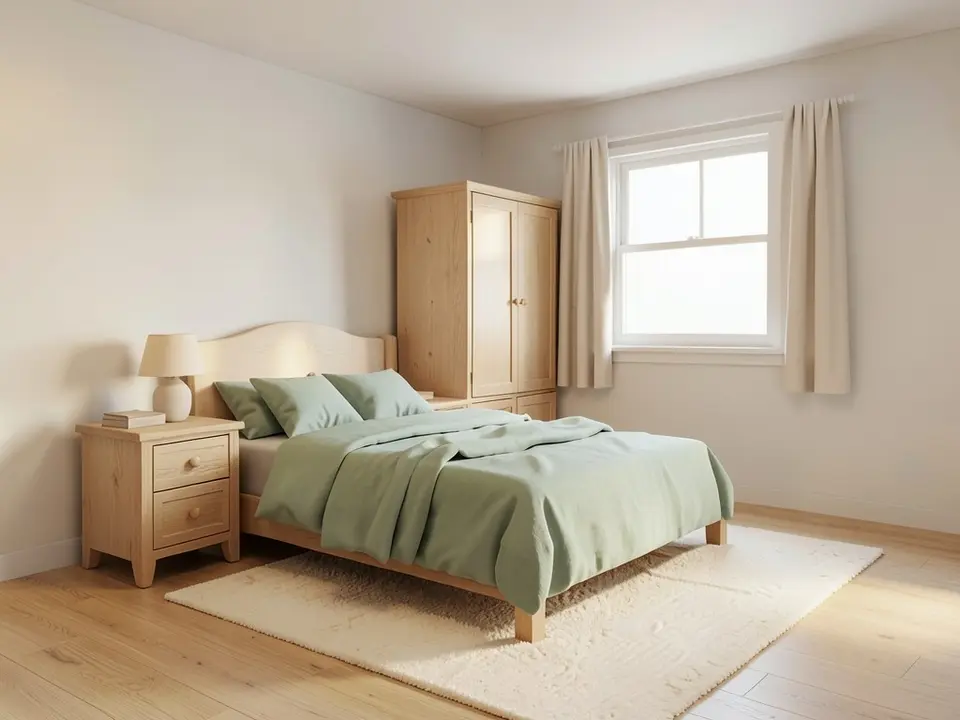
See how your room looks lit and furnished
Upload a photo or a 3D view of your room and our AI renders it furnished and finished, so you can judge the light, colors and layout before you buy bulbs or fixtures.
Render my roomSign in with Google or email to render. New accounts get 1 free render (watermarked).
Frequently asked questions
How many lumens do I need per square foot?
It depends on the room. Typical general-lighting targets are 10 to 20 lumens per sq ft for living rooms and bedrooms, 30 to 40 for kitchens and dining rooms, 30 to 50 for offices, and 70 to 80 for a bathroom vanity or a task area.
How many lumens do I need for a 12x12 room?
A 12 x 12 ft room is 144 sq ft. As a bedroom or living room at 10 to 20 lumens per sq ft, that is about 1,440 to 2,880 lumens. As an office at 30 to 50, it is about 4,320 to 7,200 lumens.
How many lumens is a 100 watt bulb?
A 100 W incandescent bulb gives about 1,600 lumens. An LED bulb of 16 to 20 W gives the same light.
How many recessed lights do I need for a room?
Divide the lumens you need by the lumens of one light, and round up. Then check the layout: space the lights about half the ceiling height apart. A 12 x 8 ft room with an 8 ft ceiling fits six lights, which at 500 lumens each is 3,000 lumens.
Is more lumens always better?
No. Too much light causes glare and harsh shadows. Aim for the range for the room, put the light in layers (ceiling, lamps and task lights), and use dimmers so you can lower it.
More free tools for architects and designers
- Room size calculator
- BTU calculator
- Living room layout
- Interior visualization
- Tile calculator
- Roof pitch calculator
- Architectural scale converter
- Cost to build a house calculator
- King size bed dimensions
- Standard door sizes
- Standard window sizes
- Bathroom vanity height
- Two car garage dimensions
- 1200 sq ft house plans
- Free house plans
Sources: Foot-candle targets are typical general-lighting ranges as published by lighting retailers and calculators such as Warehouse Lighting and Omni Calculator; they vary by source. Lumens to watts figures follow the NYSERDA consumer lighting guide and ENERGY STAR brightness points, with LED wattages from LEDVANCE. The ceiling-height allowance and spacing rule are common rules of thumb.