Free guide and calculator
CMU Block Sizes
The standard concrete masonry unit (CMU) is called an 8 x 8 x 16 block. Its actual size is 7 5/8 x 7 5/8 x 15 5/8 inches, so that with a 3/8 inch mortar joint it lays out on an 8 x 16 inch grid. Blocks also come 4, 6, 10 and 12 inches wide, all with the same 8 inch height and 16 inch length.
How many CMU blocks do I need?
Blocks (8 x 16)
284
Wall area
240 sq ft
Courses high
9
Approx. weight
284 x 35-40 lb
Uses 1.125 blocks per sq ft of wall (one 8 x 16 in nominal face = 0.889 sq ft). Subtract door and window openings from the area first. Weights are typical hollow normal-weight units; lightweight blocks are about 25% lighter.
Standard CMU block dimensions chart
| Nominal size (W x H x L) | Actual size (in) | Actual size (mm) | Typical weight |
|---|---|---|---|
| 4 x 8 x 16 | 3 5/8 x 7 5/8 x 15 5/8 | 92 x 194 x 397 | 25-30 lb |
| 6 x 8 x 16 | 5 5/8 x 7 5/8 x 15 5/8 | 143 x 194 x 397 | 30-35 lb |
| 8 x 8 x 16 | 7 5/8 x 7 5/8 x 15 5/8 | 194 x 194 x 397 | 35-40 lb |
| 10 x 8 x 16 | 9 5/8 x 7 5/8 x 15 5/8 | 244 x 194 x 397 | 42-48 lb |
| 12 x 8 x 16 | 11 5/8 x 7 5/8 x 15 5/8 | 295 x 194 x 397 | 50-55 lb |
| 8 x 4 x 16 (half high) | 7 5/8 x 3 5/8 x 15 5/8 | 194 x 92 x 397 | 18-22 lb |
Nominal vs actual CMU size
The nominal size includes one mortar joint. Masons lay CMU with 3/8 inch joints, so each block is made 3/8 inch smaller than the grid it fills. That is why an "8 inch" block measures 7 5/8 inches, and why wall lengths, door openings and heights are best planned in multiples of 8 inches.
Three courses of block make 24 inches of height. A 4 ft wall is 6 courses and an 8 ft wall is 12 courses.
Common CMU block shapes
- Stretcher: the standard hollow block with two cores, used along the run of a wall.
- Corner (end) block: one flat finished end for corners and the ends of walls.
- Half block: 8 x 8 x 8 nominal, used to keep the running bond at ends and openings.
- Bond beam block: open on top for horizontal rebar and grout, used at the top of walls and over openings.
- Pilaster and lintel blocks: for thickened columns in a wall and for spanning doors and windows.
- Split-face and ground-face blocks: the same sizes with a decorative face for walls that stay exposed.
Which CMU width should I use?
4 inch blocks are for non-load-bearing partitions and veneer. 6 inch blocks suit interior walls and low garden walls. 8 inch is the default for foundations, retaining walls under about 4 ft, and load-bearing exterior walls. 10 and 12 inch blocks are used for taller walls, basement walls with deep backfill, and fire walls. A structural engineer should size any retaining or load-bearing wall.
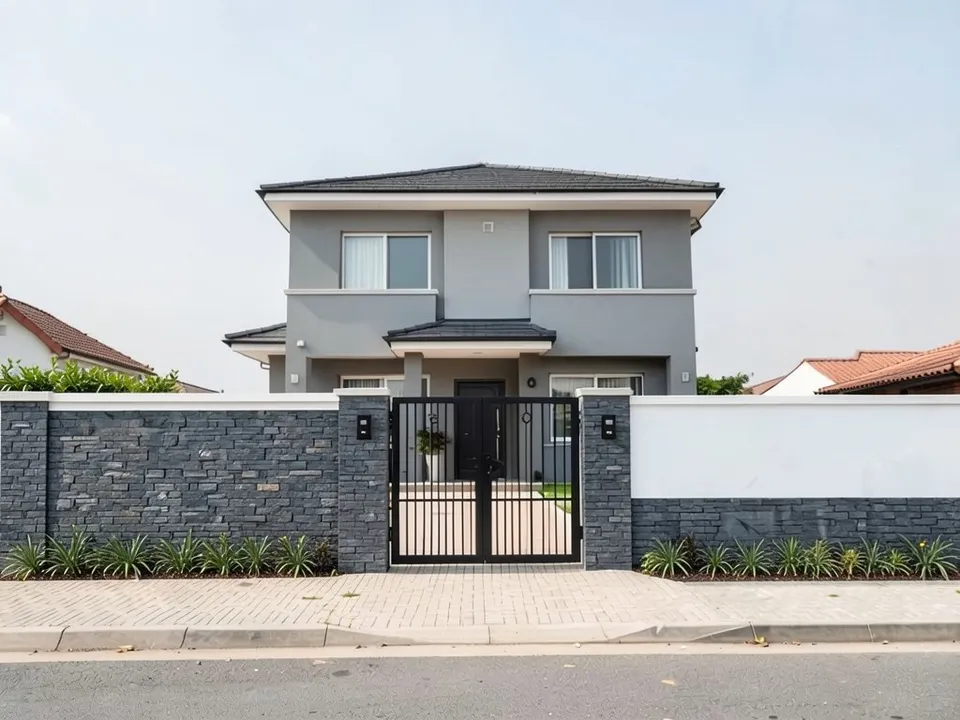
Planning a block wall around your home?
Upload a photo of your property and our AI shows the boundary wall in plain block, render, stone or a modern open design before you build it.
Try the AI boundary wall designSign in with Google or email to render. New accounts get 1 free render (watermarked).
Frequently asked questions
What is the standard size of a CMU block?
8 x 8 x 16 inches nominal, which is 7 5/8 x 7 5/8 x 15 5/8 inches actual. The extra 3/8 inch is the mortar joint.
How much does an 8 inch CMU block weigh?
A hollow normal-weight 8 x 8 x 16 block weighs about 35 to 40 lb. A lightweight block of the same size is about 28 lb.
How many CMU blocks are in a square foot?
1.125 blocks of 8 x 16 inch face per square foot of wall, or 112.5 blocks per 100 sq ft. Add about 5% for cuts and breakage.
What sizes do CMU blocks come in?
Nominal widths of 4, 6, 8, 10 and 12 inches, all 8 inches high and 16 inches long. Half-high (4 inch tall) and half-length (8 inch long) units are also made.
Is a cinder block the same as a CMU?
Cinder block is the old name for blocks made with coal cinders. Most blocks sold today are concrete masonry units made with sand, gravel or lightweight aggregate, in the same sizes.
More free tools for architects and designers
- AI boundary wall design
- Tile calculator
- Roof pitch calculator
- Architectural scale converter
- Cost to build a house calculator
- King size bed dimensions
- Standard door sizes
- Standard window sizes
- Bathroom vanity height
- Two car garage dimensions
- 1200 sq ft house plans
- Free house plans
Sources: Dimensions follow ASTM C90 modular sizes used by US block manufacturers and the National Concrete Masonry Association (NCMA). Weights are typical ranges; check the maker's data sheet.